
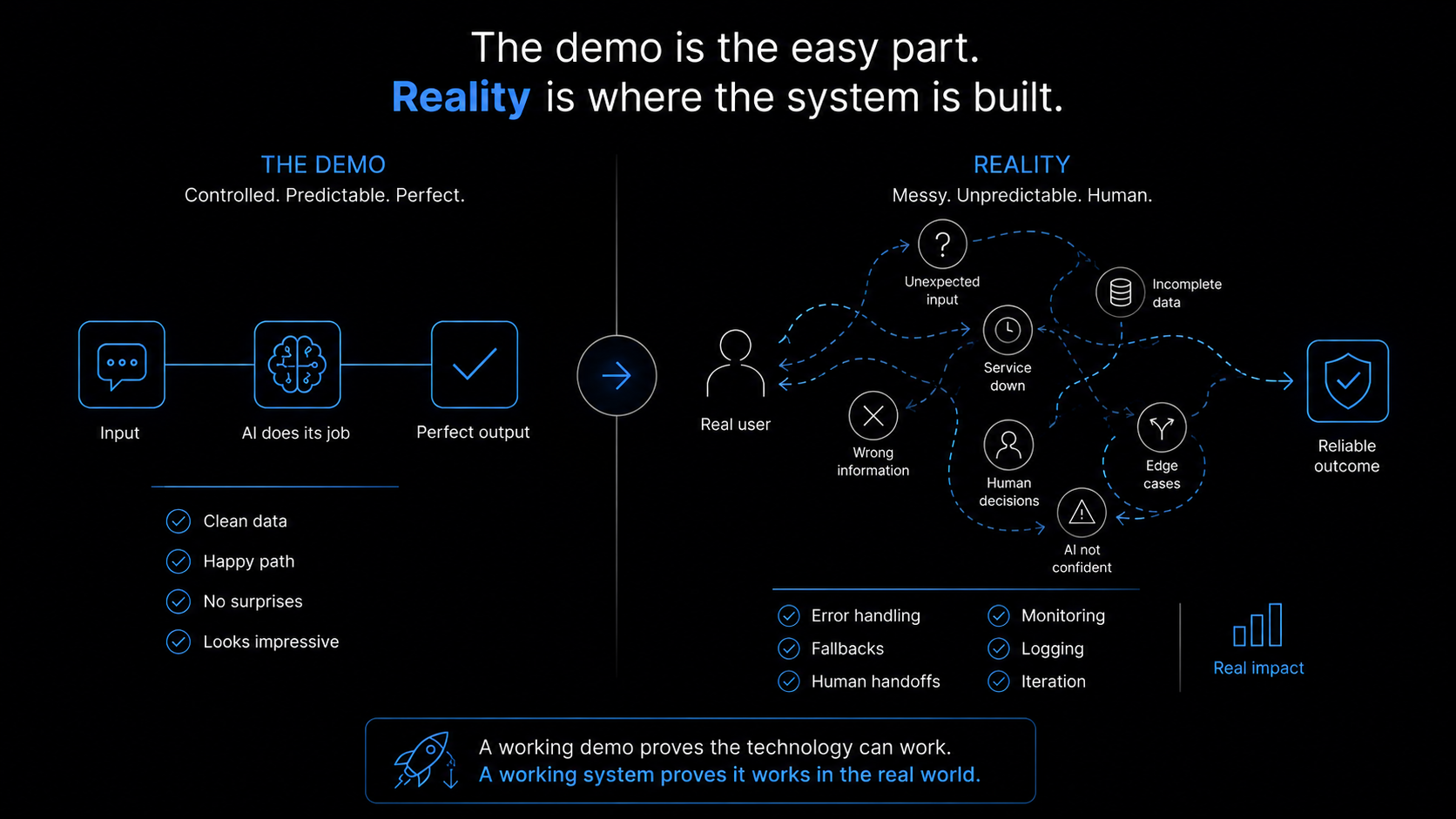
There is a particularly satisfying moment when building with AI.
You press the button.
It works.
The voice agent answers correctly. The automation sends exactly what it should. The dashboard updates. The AI understands the question you deliberately designed it to understand.
You sit back and think:
Well, that was easier than expected.
And then you give it to an actual human.
This is where things get interesting.
Real users don't follow your demo script. They enter incomplete information. They change their minds halfway through a conversation. They use terminology you didn't anticipate. They click twice. They don't click at all. They find an edge case within seven minutes that somehow never occurred to you during three weeks of building.
Real businesses are even messier.
When I worked on an inventory system, recording a sale was straightforward. But not everything leaving the shelf was a sale.
What about a free sample?
What about the slightly generous extra scoop?
What about stock that expires?
What about the tray that physically weighs less than the system says it should?
Suddenly, the problem isn't getting the software to deduct 500 grams from inventory.
It's designing a system that understands how inventory actually moves through the business.
I've found the same thing with AI voice agents. Getting an AI to have a convincing conversation is impressive, but it's only part of the system.
What happens when it doesn't understand someone? When should it stop trying and involve a human? What gets recorded after the call? What happens to an interested lead? What if the service it depends on goes down?
The same lesson showed up again while building a contract review system for a boutique law firm. Getting AI to read a document and flag a risky clause is the impressive part, the part people want to see in a demo.
But what happens when it's confident about the wrong clause? What happens when a document doesn't follow the format it expects? Who signs off before anything reaches a client? What's the cost of being wrong once, in a profession where being wrong once is expensive?
In legal work, the AI doesn't get to be the last word. It gets to be the first pass.
The AI is often the exciting part.
The exceptions, handoffs, integrations and decidedly unexciting fallback rules are what make it useful.
That's why I think we sometimes celebrate AI demos a little too early.
A successful demo answers:
Can this work?
Putting it into a real workflow asks a much harder question:
Can this keep working when reality gets involved?
That's where testing, observing, refining and occasionally rebuilding things begins.
So when a demo works, I absolutely celebrate.
For approximately five minutes.
Then I start trying to break it.