
We seem to have reached the stage of AI where everything wants to become an agent.
Sales agent. Customer service agent. Research agent. Operations agent. Marketing agent.
Give it a few months and my coffee machine will probably have goals, memory and permission to negotiate with the toaster.
Agents are genuinely exciting. I've built with them, and there are problems where giving AI the ability to reason, use tools and decide what to do next makes perfect sense.
But there are also plenty of problems where it doesn't.
Imagine a business receives an order.
The order needs to be entered into a system, inventory needs to be reduced, the kitchen needs to be notified and the owner wants the numbers reflected on a dashboard.
Do we need an AI agent sitting in the middle, thoughtfully reasoning about every order?
Probably not.
The workflow is predictable. The rules are known. Good old-fashioned software and automation can handle most of it faster, cheaper and more reliably.
Now imagine an incoming customer message:
“We're organising Diwali gifts for around 300 employees. Some need sugar-free options, we're not sure about the budget yet, and can you deliver to three offices?”
That's different.
There is ambiguity. Information needs to be gathered. Questions need to be asked. Context matters. The next step depends on the previous answer.
Now AI starts earning its place.
This distinction matters because it's incredibly tempting to use the most interesting technology available rather than the simplest technology that solves the problem.
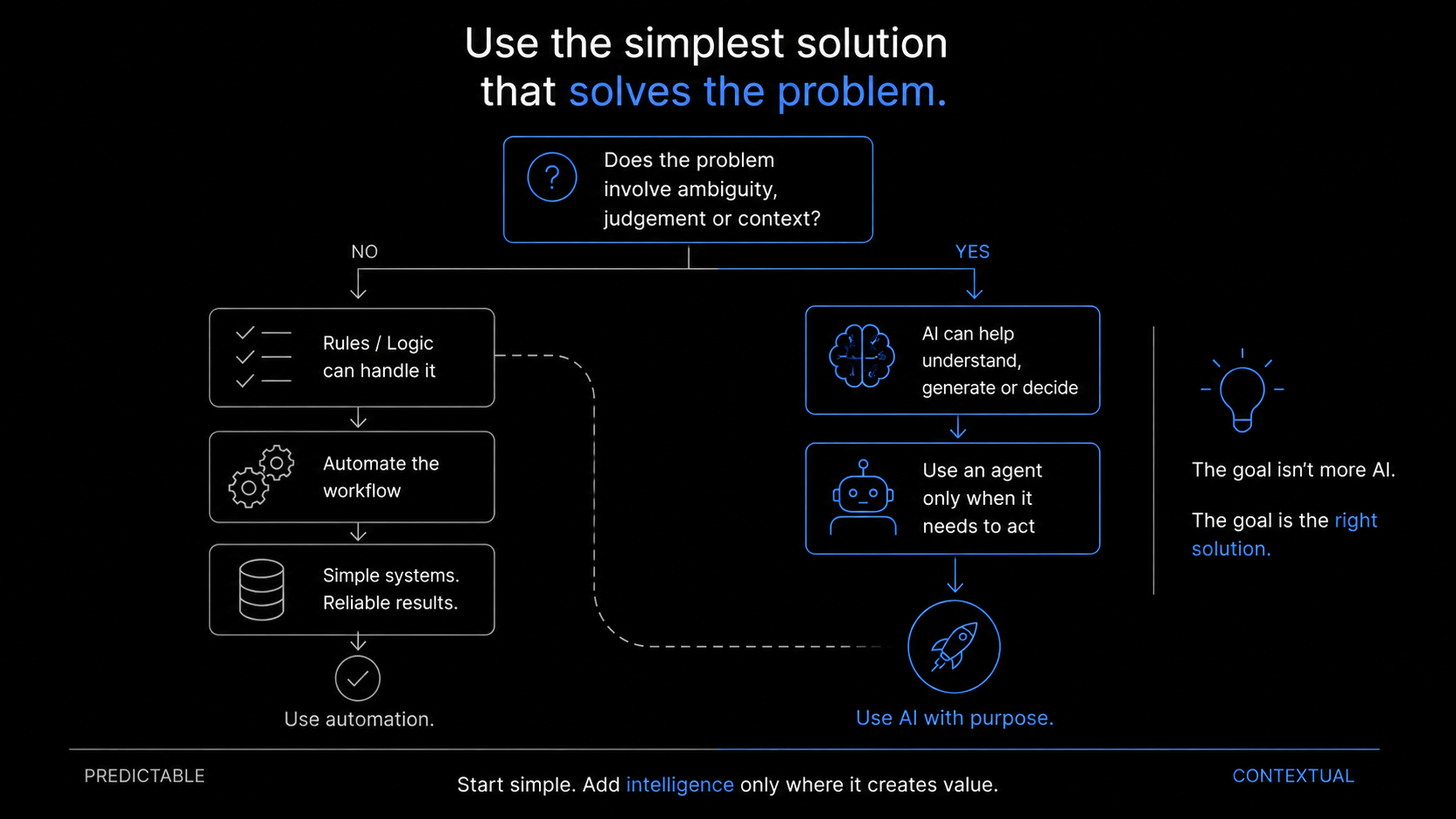
When I look at a workflow, I increasingly think of it as a ladder.
Can a simple rule handle this?
If not, can we automate it?
If that isn't enough, would AI help interpret or generate something?
And only when the system genuinely needs to make contextual decisions do we start talking about agents.
Sometimes the final solution will contain all of these. Ordinary software underneath, deterministic automations moving information around, and AI used only where judgement or ambiguity enters the picture.
That might sound less exciting than announcing an autonomous multi-agent architecture.
I'm fine with that.
The goal isn't to put as much AI as possible into a business.
It's to solve the problem with as much AI as necessary.
And sometimes, the smartest AI decision is knowing when not to use it.